
Finance course staple
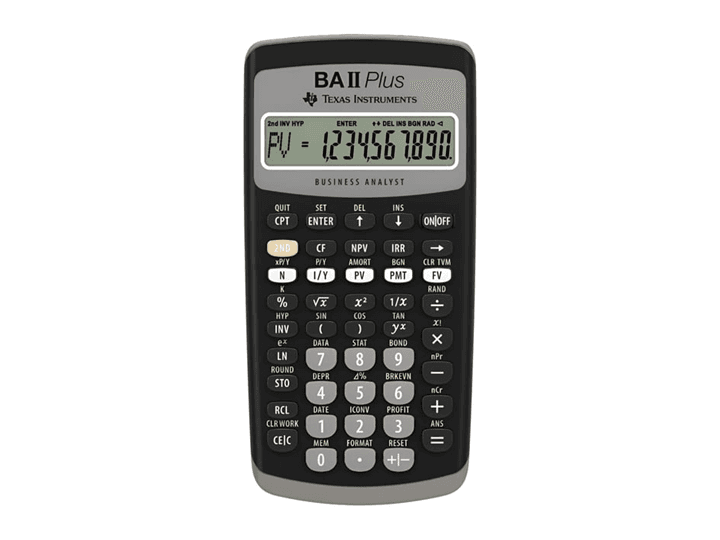
Texas Instruments BA II Plus
Business, accounting, CFA-style study, TVM, NPV, and IRR
A widely recommended financial calculator because the worksheet layout is familiar across finance courses.
View on Amazon.co.uk
Guide - Calculator Buying
A financial calculator is built for money maths: time value of money, cash flows, loan amortisation, bond yields, and depreciation. If those are daily tasks, it is faster and less error-prone than forcing everything through a standard scientific calculator.
Product links go to Amazon.co.uk with the affiliate tag applied.
Finance course staple
Business, accounting, CFA-style study, TVM, NPV, and IRR
A widely recommended financial calculator because the worksheet layout is familiar across finance courses.
View on Amazon.co.uk
Classic RPN pick
Finance professionals, valuation work, and RPN users
A long-running professional finance calculator with a dedicated following and compact horizontal layout.
View on Amazon.co.uk
Value finance option
Students who need TVM and cash-flow functions without a premium price
A practical alternative for loans, cash flows, bond-style maths, and business finance coursework.
View on Amazon.co.ukAt minimum, look for TVM keys for present value, future value, payment, rate, and number of periods. Those are the backbone of loan, mortgage, annuity, and investment calculations.
For finance courses and analysis work, cash-flow worksheets for NPV and IRR are essential. Bond pricing, yield to maturity, depreciation, break-even, and statistics functions are useful extras.
Most people are comfortable with algebraic entry, where expressions resemble the order you write them in. RPN is faster for some finance professionals once learned, but it has a learning curve.
If you are buying for a course or exam, match the calculator used by the tutor or textbook wherever possible. The time saved on examples can be bigger than the hardware difference.
Professional exams often publish their own permitted calculator lists. Do not assume that a powerful model is allowed just because it is finance-specific.
If you are studying accounting, CFA-style investment analysis, actuarial modules, or business finance, check the current exam policy before buying.
| Need | Look for | Why |
|---|---|---|
| Loans and mortgages | TVM and amortisation | Fast payments, balances, and interest splits |
| Investment appraisal | Cash flows, NPV, IRR | Handles uneven project cash flows |
| Fixed income | Bond price and yield | Useful for coupons, maturity, and yield to maturity |
| Professional exams | Permitted model list | Exam compliance matters more than features |
TVM means time value of money. The usual keys are present value, future value, payment, interest rate, and number of periods. Together they solve loan, savings, annuity, and mortgage problems.
If your course covers TVM, NPV, IRR, bonds, amortisation, or corporate finance, a dedicated financial calculator is usually worth it. Match the model recommended by your lecturer or exam provider.
It can do some underlying maths, but it will not be as quick for TVM, cash-flow, bond, or amortisation workflows. A spreadsheet can also help, but exams may not allow it.